-
1216 Views
You know you need to be creating content. Everyone says so. Your Instagram is gathering dust, your blog hasn’t been touched since last year, and your newsletter has been ‘coming soon’ for six months. But when you finally sit down to do something about it, you stare at a blank page and think: where do I even start?
And then, even if you do start, the question becomes: how do you keep going? How do you show up on LinkedIn, send a newsletter, post a reel, write a blog, and still run your actual business at the same time?
The honest answer is… you don’t. Not if you’re treating every piece of content as a separate thing to create from scratch.
But if you build a system where one piece of content feeds everything else? That changes everything.
This is exactly how we work at Base Brands. And in this article, we’re going to show you the whole thing.
Why most people struggle with content consistency
The problem isn’t effort. Most business owners we speak to are trying. They write a caption, post a photo, maybe record a reel on a good day. But it’s scattered. There’s no thread connecting it all, no system underneath it.
The result? Content that feels random, an inconsistent presence across channels, and the nagging feeling that you’re spending time on it without seeing any return.
The real issue is this: they’re creating content, not producing it. There’s a not so very little difference.
Creating content is reactive. It’s sitting down and thinking “what should I post today?” Producing content is systematic. It’s having a process that generates multiple outputs from a single input, every single time.
The shift from creating to producing is what unlocks consistency — and consistency is what builds an audience.
The content engine: one idea, every channel nailed
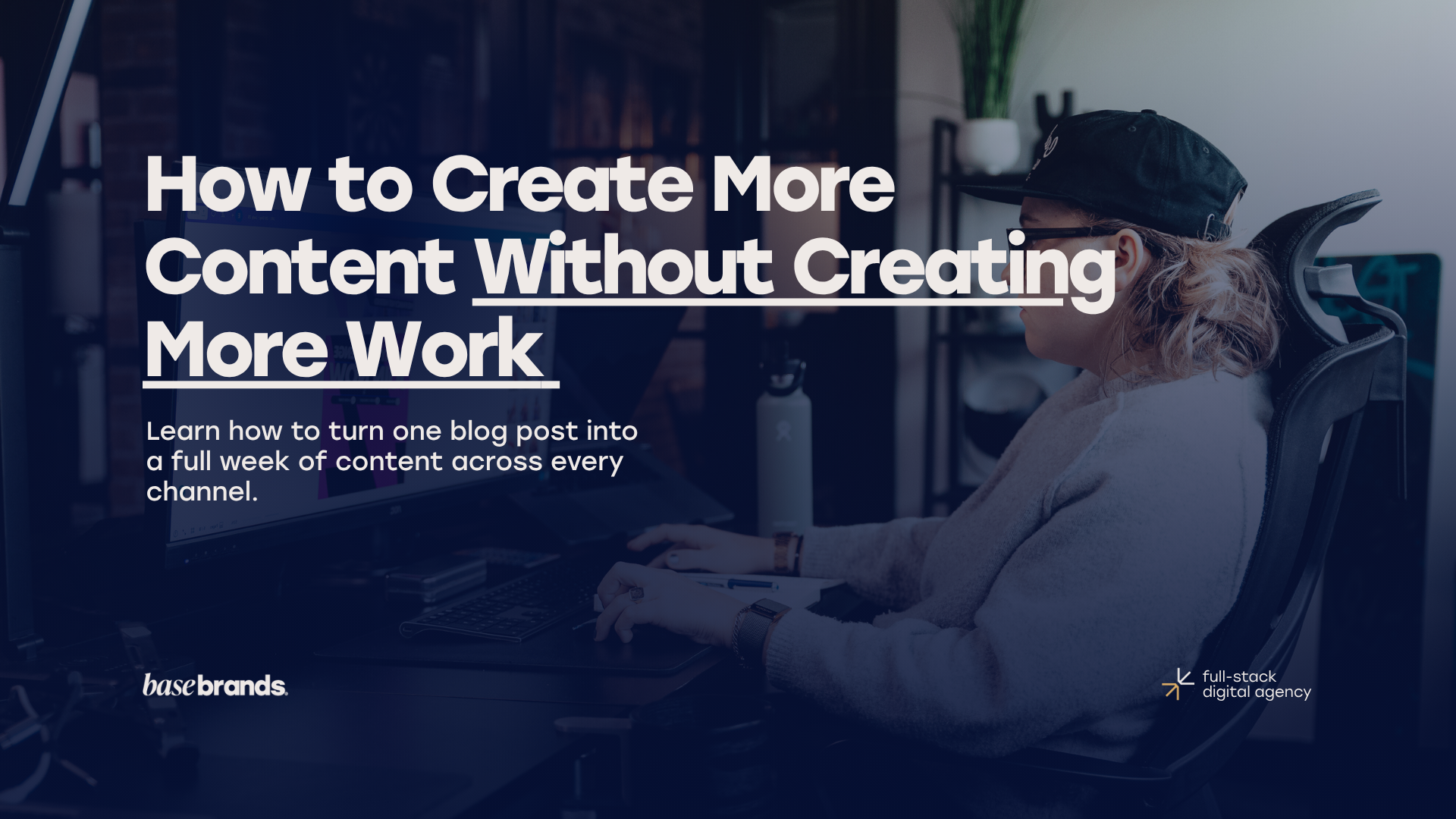
At Base Brands, we operate what we call a content engine. It’s a five-step process that takes a single idea and turns it into a full week of content across every channel, from blog, newsletter, social media and video. The same system works whether you have a team or you’re doing it all yourself.
Here’s how it works.
Step 01: Pick your topic
Start with what your audience needs to know. Not what you feel like writing about; what they are actively searching for, asking about, or struggling with. Your best ideas come from client conversations, questions you keep getting asked, trends in your industry, and things you’ve learned the hard way.
Step 02: Research it first
Before you write a single word, validate the idea. Use a free tool like Google Search Console, Ubersuggest, or even just Google’s autocomplete to understand what people are actually searching for around this topic.
What angle ranks? What questions come up? What’s already out there, and how can you do it better?
Step 03: Write the blog (this is your anchor piece)
The blog is the engine. Everything else comes from it. Write it long-form, write it well, write it like you’re explaining something to a friend.
SEO structure matters here too; use clear headers, answer real questions, be specific. Aim for 1,000 to 1,500 words minimum.
Step 04: Repurpose across three channels
Your newsletter is the core insight from the blog, written raw and personal; no polish needed, just your honest take.
Your social copy is the blog broken into carousels, static posts and captions, each section becomes a slide, the intro becomes a hook, the conclusion becomes a call to action.
Your video or reel is a 60-second take on the same topic, filmed on your phone, no studio required. Record it in one take and edit out the waffle.
Step 05: Publish and schedule
Batch everything in one session. Schedule it across the week using a tool like Buffer or Later. Stagger it so you’re showing up consistently rather than dumping everything at once. Monitor what lands, and double down on what works.
What actually comes out of one blog post
Here’s what a single blog post generates when you run it through this system:
- 1 newsletter edition > written from the heart, sent to your list
- 2 to 3 carousel posts > each section of the blog becomes a slide deck
- 3 to 5 static captions > short, punchy takes pulled from the key points
- 1 short-form video > your verbal take on the topic, 45 to 90 seconds
- 1 optimised blog post > live on your site, working in search forever
That’s eight to eleven pieces of content from one idea. One research session. One writing session.
Oh, and the blog? It keeps working long after the social posts have disappeared into the algorithm. A well-optimised blog post can drive traffic for months or years.
Your social posts have a lifespan of about 48 hours. That’s why the blog is the anchor, it’s the only piece of content with genuine longevity.
The honest bit… what it actually takes
We’re not going to pretend this system runs itself. Here’s what it genuinely requires:
- One strong idea per week. That’s it. You don’t need 10 content pillars and a 90-day strategy. You need one thing your audience genuinely needs to know, every week.
- One writing session. Block two hours. Write the blog. Don’t edit as you go, just write. The editing is a separate session.
- One batching session. After the blog is done, spend another hour pulling the newsletter, the captions and the video script from it. It’s faster than you think when you already have the source material in front of you.
- Consistency over perfection. The brands that win at content are not the ones who publish the most polished posts. They’re the ones who show up every week, without fail, for a year (or more… lol).
The biggest mistake we see? People wait until they have time to do it properly. That time never comes. The goal is to make the system small enough that you can run it on your worst week, not your best.
How we do it at Base Brands
At Base Brands, this isn’t theory. This is our actual weekly process.
Our content starts with a topic, usually something that’s come up in a partner conversation, a trend we’ve noticed in brand work, or a question we keep getting asked. We run it through a quick keyword check to make sure there’s real search demand, then we write the blog. Long-form, SEO-structured, written like we talk.
From that one piece, our team pulls the newsletter, the social copy and records the video content. Our in-house designer creates the carousel graphics and blog thumbnail. Everything goes through a review, gets packaged up, and then it’s scheduled and live.
One idea. One week. Every channel covered.
We’ve found that this approach doesn’t just save time, it creates a consistency of voice and message that you simply can’t get from posting reactively. When everything comes from the same source, it all feels cohesive.
Your audience starts to recognise your perspective, your tone, your way of thinking about things. That’s what builds trust. That’s what builds an audience.
Frequently asked questions
Do I need to be on every channel?
No. Pick the two or three channels where your audience actually spends time. The system works just as well with one social platform, a newsletter and a blog. Don’t spread yourself across six channels just because they exist.
What if I’m not a good writer?
Write like you talk. That’s it. Read it back out loud, if it sounds like you’d actually say it, it’s good enough. The most effective content is specific and honest, not polished and perfect. If writing is genuinely not your thing, record yourself talking through the topic and transcribe it. That’s a blog post.
How long should the blog be?
Long enough to actually answer the question you’ve set out to answer. For most topics that’s anywhere between 500 and 2,000 words. Don’t pad it out, but don’t leave things out for the sake of being brief. Google rewards thoroughness when it’s genuinely useful.
What if nobody reads it at first?
They won’t. At first. Content builds slowly, then suddenly. The brands and people who have large, engaged audiences didn’t get there overnight, they showed up consistently for a long time before it compounded. Build the engine now. The worst time to start a content strategy is when you urgently need leads.
Want this system built for you?
At Base Brands, we build content engines for businesses that want to show up consistently without it taking over their week. From strategy and keyword research through to design, SEO and scheduling, we run the whole thing.
If you’d like to talk about what that looks like for your business, get in touch, we’d love to hear from you.